
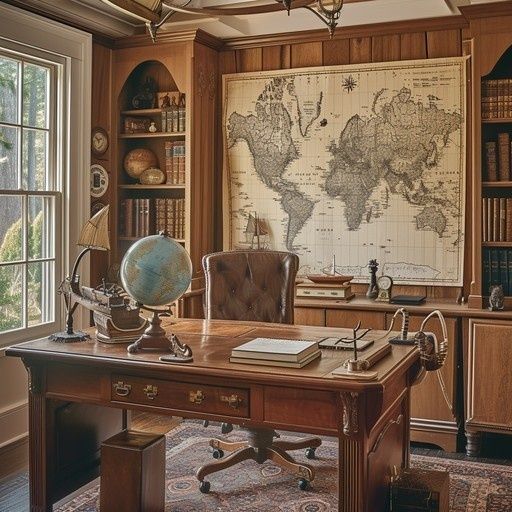
Designing an Expedition Base Camp in Your Home Workspace
Reclaiming the Home Office as a Frontier Encampment
A home office can be perfectly tidy and still feel strangely hostile to concentration. Smooth white surfaces, synthetic accessories, hidden cables, and a screen that dominates every task may create visual calm, yet they can also make work feel detached from the physical world. Remote professionals often move through the day between browser tabs, messages, and video calls without a clear sense of place. The result is a particular kind of fatigue: the body remains at home while the mind is continually dispatched elsewhere.
Historic winter expeditions offer a different model. A winter camp was not decorated for appearance alone. Every wall, storage area, tool, and working surface served a purpose. Order protected scarce supplies, reduced wasted movement, and helped a crew maintain morale when weather and uncertainty pressed in from every direction. Your workspace can adopt the same logic. Treat it as a base camp for sustained exploration, where physical arrangement supports deep focus, protects important work, and gives long projects a visible route forward.
Historical Architecture of Survival and Focus
Winter quarters were designed around practical survival. Shelter had to resist rain, wind, cold, dampness, and disorder while keeping people close enough to coordinate. A useful camp separated functions without isolating the crew: sleeping, storing, repairing, preparing food, recording observations, and planning the next movement each required a recognizable place. This arrangement limited confusion during difficult conditions because essential objects could be found quickly and repeated tasks followed dependable patterns.
The Corps of Discovery”s winter encampment at Fort Clatsop illustrates this disciplined pause in a demanding journey. The Corps occupied the site from December 1805 through March 1806, using the period not simply to wait out the weather but to collect supplies, produce salt and leather, and prepare maps and journals. The camp housed 32 men, one woman, a baby, and a dog, making organization a practical necessity rather than a decorative preference. Much like the Corps of Discovery establishing their resilient shelter at Fort Clatsop, as documented by the National Park Service, your workspace requires deliberate spatial discipline to protect ongoing creative work.
Translate that lesson into a room by defining the territory before adding equipment. The purpose is not to imitate a historical fort literally, but to create an intentional outpost that tells your mind what happens there. Begin with three zones: a primary work surface for active thinking, a supply area for frequently used tools, and a reference area for material that supports longer campaigns. Keep domestic clutter outside those boundaries wherever possible. The psychological transition is powerful because entering a deliberately arranged station signals readiness, much as arriving at an established camp signals that the next phase of the expedition can begin.
- Protect the working core: reserve the central desk area for the current task rather than general storage.
- Assign every essential tool a location: notebooks, chargers, pens, headphones, and reference books should be recoverable without a search.
- Separate active and inactive material: current drafts belong within reach, while archives should occupy a distinct shelf or box.
- Build for recovery: include water, task lighting, a comfortable chair, and enough clear space to reset between demanding sessions.
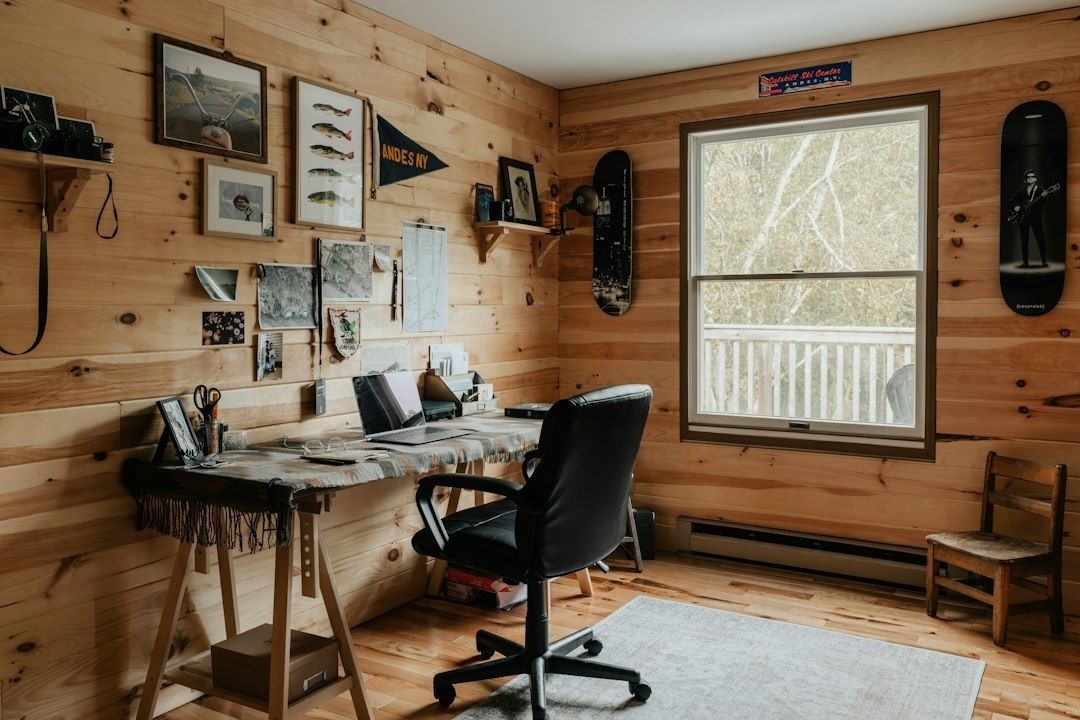
Replacing Sterility with Tactile Frontier Materials
Sensory monotony can quietly drain attention. A desk dominated by identical synthetic surfaces offers little variation for the eyes or hands, while a monochromatic environment may make every workday feel interchangeable. Tactile materials introduce small physical signals that reconnect attention with the immediate environment. The grain of wood, the weight of a brass clip, the texture of canvas, or the soft resistance of full-grain leather can make ordinary actions feel deliberate rather than purely digital.
Material choices should remain functional, modest, and durable. Untreated or lightly finished wood can provide a warm, visually stable base. Canvas folders and tool rolls hold cables, notebooks, or field supplies without the visual sharpness of plastic containers. Patinated brass works well for clips, desk lamps, or map pins, while full-grain leather can serve as a writing mat, notebook cover, or document sleeve. Research into cognition does not prove that a frontier-style desk automatically creates focus, but broader work on cognitive load supports a useful principle: the environment should reduce needless friction while preserving the right amount of challenge. A related Nature study on cognitive performance and environmental attention offers a valuable reminder that the relationship between surroundings and sustained human focus deserves careful consideration.
| Conventional home desk | Expedition-inspired alternative | Practical benefit |
|---|---|---|
| Glossy synthetic organizer | Canvas tool roll or wooden tray | Makes frequently used tools visible and easy to retrieve |
| Disposable plastic folders | Cloth or leather document sleeves | Separates active work from archived material |
| Monochromatic wall decor | Topographic print or working map | Provides spatial context and a visual project anchor |
| Decorative metal objects | Patinated brass clips, pins, or lamp hardware | Adds weight and tactile feedback to routine actions |
The Physical Charting Wall and Field Log Stations
Digital project boards are efficient, but they can flatten a complicated campaign into columns that disappear behind other windows. A physical charting wall gives work a location in space. When deadlines, questions, source notes, and decisions occupy different positions, the project becomes easier to survey as a whole. Spatial memory can then support recall: a particular note may be remembered not only by its words but by its position beneath a map, beside a deadline, or near a cluster of unresolved questions.
Build the wall gradually rather than covering it with decoration. Choose a corkboard, fabric-covered panel, magnetic sheet, or a section of wall that can accept removable hooks. Add a topographic print, transit map, coastline chart, or another image that reflects the shape of the work. Use index cards for tasks and small paper slips for questions. Keep the system flexible, because a chart that cannot change will soon become an archive instead of a command center. The aim is to externalize the campaign sufficiently that your working memory is not forced to carry every open loop.
- Mark the mission area. Place the project title, central question, desired outcome, and current deadline at the top of the board.
- Create three surface zones. Label them mission staging, archival reference, and active drafting so that each item has a clear destination.
- Stage the next movements. Put only the next few actions in the mission zone. This keeps the board actionable instead of overwhelming.
- Build the archive. Pin source notes, quotations, diagrams, and decisions that may be useful later but do not require daily attention.
- Maintain an active drafting strip. Keep the paragraph, argument, outline, or technical problem currently under construction in one visible row.
- Log the day”s findings. End a work session with a short dated note stating what changed, what remains uncertain, and where the next session should begin.
A field log station can sit beside the charting wall or on the desk itself. Use one durable notebook for observations, decisions, and questions that might otherwise vanish into scattered applications. The notebook is not a replacement for digital records or backups; it is a control surface for thought. The broader idea aligns with theories of embodied and active cognition, including work describing how agents build coherent models of their environment in order to select actions. A visible map of the project gives your mind a stable model from which to choose the next move.
Operational Readiness Rituals for Daily Campaigns
Expedition work benefits from a morning muster, even when the expedition consists of writing, analysis, design, or research. Before opening email or communication tools, spend five to ten minutes reviewing the charting wall and writing a simple operational brief. Identify the day”s primary objective, the smallest useful first action, and one condition that would count as meaningful progress. This prevents incoming messages from assigning the day”s priorities before you have consulted the larger mission.
Readiness also depends on reducing small decisions. Keep a compact gear station near the desk with the items that begin a work block: notebook, pen, headphones, water, charger, and any reference material. A consistent checkpoint turns preparation into a sequence instead of a negotiation. Cognitive load research emphasizes that attention is shaped by how tasks and information are structured, while strategic challenge can support deeper learning and resilience. The goal is therefore not to remove every difficulty, but to reserve mental energy for the difficult work that actually matters.
- Morning muster: review the mission statement, choose one priority, and write the first physical action.
- Gear check: confirm water, power, reference material, lighting, and a clear working surface.
- Communication window: delay messages until the first meaningful focus block when circumstances allow.
- Midday resupply: stand, move, eat, and reassess whether the plan needs a realistic adjustment.
- Evening shutdown: record the next step, return tools to their stations, close work applications, and cover or clear the active drafting area.
The evening camp shutdown is especially important for remote professionals because home and workplace share the same coordinates. Write a brief log entry before stopping, then physically change the room: switch off the task lamp, close the notebook, place the keyboard away, or cover the charting surface with a cloth. These actions create a boundary that software alone cannot provide. The next morning, the prepared station will make re-entry easier, while the rest of the home can once again belong to rest, conversation, and ordinary life.
Chart Your Course and Establish Camp Today
The expedition base camp framework changes remote work from passive telecommuting into active expeditionary management. Your desk becomes a place with a mission, your wall becomes a chart, your notebook becomes a field log, and your routines become readiness procedures. None of this requires theatrical props or expensive renovation. It requires clear zones, reliable storage, visible priorities, and materials that make the work feel grounded in the physical world.
This weekend, begin with three low-cost changes. Clear one surface completely, add a corkboard or sheet of cardboard for project mapping, and assemble a small tray containing the tools used at the start of every work block. Move one distracting object out of sight, place a durable notebook within reach, and write the next expedition objective by hand. Approach demanding quarters with the endurance and curiosity of an explorer. A well-built camp does not remove the wilderness from the journey, but it gives you the order, stamina, and perspective needed to keep moving through it.
By Magnus
- 28, Sep, 2026
- 0 Comments